AMRs in warehouses: Smarter logistics through automation

Understanding how AMRs improve warehouse operations
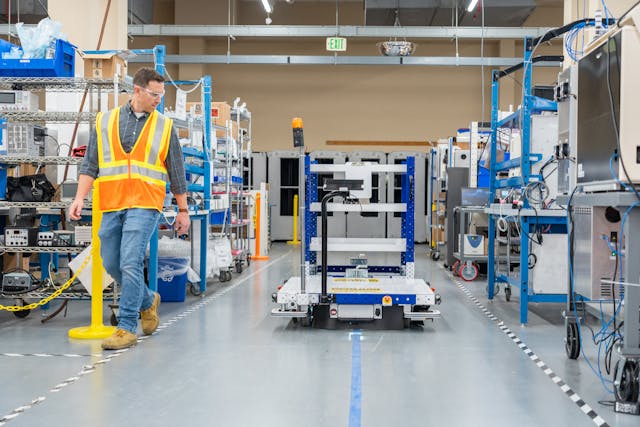
Warehouses today rely on AMRs (Autonomous Mobile Robots) to move materials more efficiently and reduce unnecessary manual handling. These robots use built-in navigation systems to travel through the facility on their own, safely avoiding obstacles and following planned routes. By taking over routine transport tasks, they help minimize downtime, reduce physical strain for workers, and free up time for the operators.
AGV vs. AMR – what’s the difference?
5 reasons why warehouses invest in AMRs for automation
Investing in AMRs brings clear, measurable benefits for modern warehouses. Their flexibility is unmatched – they adjust easily to new layouts or workflows without major changes, which lets them perform well in operations with fluctuating demand. As your business grows, you can scale gradually by adding more robots without large upfront costs.
Here are five reasons why warehouses invest in an AMR system:
- Faster, smarter material handling
- Cost savings and quick return on investment
- Unrivaled flexibility in day-to-day operations
- Scalable solutions for growing supply chains
- Safer and more accurate warehouse processes

The technology powering AMR robots
Real-world impact of AMR warehouse solutions
Warehouses that have chosen to deploy AMRs are seeing the difference every day. These robots take on the routine transport work, helping speed up how materials move between storage, assembly, and shipping areas. As a result, operators can spend less time on heavy, repetitive lifting and more time on work that benefits from their expertise.
Their advanced safety features have also made a difference for clients around the world, helping to reduce various accidents, especially in areas with lots of activity and foot traffic. Over time, these upgrades have led to smoother workflows, fewer interruptions, and a clear drop in handling mistakes. For many businesses, the investment in AMRs has paid off within a couple of years, proving to be a reliable way to speed up warehouse routines and improve safety without causing disruption.
Customer case: Heavy truck manufacturer
Bringing AMRs into your warehouse
Preparing for a smooth Implementation
Getting your AMRs up and running in your warehouse starts with mapping out your processes. Look at transport routes, how frequently tasks occur, and where delays happen. Running a pilot test is a great way to validate the system before going full scale. Make sure your wireless network is solid and your employees get proper training for a smooth transition.
Overcoming common integration challenges
During this process, you might face hurdles like adapting older WMS systems, designing pathways that fit both robots and people, managing mixed traffic zones, and keeping disruptions low during installation. Working with experienced solution providers, like FlexQube, can smooth out these challenges early on and keep your implementation on track.
Questions asked about AMRs in warehouses
Up next

8 December 2025
FlexQube receives pilot order for AMR system from leading European retail company
FlexQube has received a pilot order worth 1.1–2 MSEK for its Navigator Autonomous Mobile Robot (AMR) system from one of Europe’s largest fashion and retail companies. The 12-week pilot will take place in Q2 2026 at a customer facility in Poland, with potential for broader rollout across Europe and globally.
10 December 2025
Automated Guided Vehicles (AGV): Meaning, types, and the future of logistics
An Automated Guided Vehicle (AGV) is a self‑propelled transport vehicle that moves materials inside factories, warehouses, hospitals, or distribution centers without a human driver. It uses navigation tools — such as magnets, wires, lasers, or sensors — to follow fixed or semi-fixed paths. AGVs carry pallets, racks, containers or other heavy loads.