AGV navigation systems – a complete guide

AGV navigation basics – how to get started
When implementing an AGV (Automated Guided Vehicle) solution, one of the most important considerations is how they navigate within your facility. An effective AGV navigation system determines an AGV’s route, while also impacting flexibility, scalability, and long-term operational performance.
In this guide, we’ll explore the main AGV navigation types used in industry today, from laser systems to optical navigation, and share insights into what to consider when choosing a system that fits your facility’s needs.
By understanding how AGVs navigate, you can ensure your automation strategy supports both current operations and future expansion.
What is AGV navigation?
At its core, AGV navigation refers to the technology and techniques an AGV uses to understand its position and follow a path within a facility. It forms the foundation of the entire solution, fine-tuning your workflow by working hand in hand with fleet management tools, safety features, and system integrations like warehouse management software.
Let us go through some of the most common navigation types:
- Laser-guided navigation
- Natural navigation
- Magnetic tape navigation
- Magnetic spot navigation
- Camera/Optical line navigation
1. Laser-guided navigation
Laser-guided navigation is one of the most widely used and precise AGV navigation systems in industrial environments. The system uses rotating laser scanners that send out beams and read their reflections from reflectors installed across the facility. Based on the angle and distance of reflected laser signals, the AGV calculates its exact position.
It is mainly used for its:
- Accuracy: Laser navigation delivers high positioning precision and is perfect for tasks like precise pick-up, drop-off, or docking.
- Flexibility: Routes can be changed via software and don’t require physical guide lines or floor markings.
- Reliability: Works consistently in complex layouts with multiple AGVs.
This makes laser guidance especially suitable for large warehouses, distribution centers, and manufacturing environments that require tight routing and minimal physical infrastructure.
2. Natural navigation (free navigation)
Natural navigation, also called free or feature-based navigation, is the most advanced approach among AGV navigation types. Instead of relying on installed tape, reflectors, or magnets, AGVs use natural navigation to scan and map their environment using onboard sensors such as lidar, cameras, or other range-finding technologies.
These AGVs build a digital map of the facility by identifying features such as walls, racks, pillars, or fixed machinery and localize themselves against this map. By applying advanced algorithms, the vehicle can calculate exactly where it is within the environment.
Some of the main benefits are:
- No infrastructure changes: Eliminates the need for floor tape, reflectors, or magnets.
- Adaptability: Capable of adjusting to minor layout changes without physical reconfiguration.
- Future-ready: Offers more flexibility compared to fixed path systems.
The use of natural navigation is growing rapidly, particularly in dynamic environments where layouts change often.
3. Magnetic tape navigation
Magnetic tape navigation is one of the classic and cost-effective AGV navigation systems. In this setup, magnetic strips are simply adhered to the floor in predefined paths. AGVs are equipped with magnetic sensors that detect the tape’s magnetic field and follow it to navigate.
What makes this method valuable:
- Low initial cost: Tape is easy to install with minimal upfront investment.
- Simple to maintain: Sensors read the tape reliably in consistent environments.
- Predictable routes: Paths are fixed and repeatable.
Magnetic tape systems are typically best suited for facilities with stable workflows and limited need for frequent path changes, since modifying routes means physically changing the taped layout.
4. Magnetic spot navigation
Magnetic spot navigation takes a slightly different approach. Instead of continuous tape, small magnetic spots are embedded in the floor at specific locations. These spots act as reference points that help the AGV localize along a path and confirm its position.
Some of the main benefits are:
- Good reference accuracy: Spot markers help AGVs maintain precise route knowledge.
- Lower infrastructure use compared to tape: Fewer markers can be required, depending on layout.
Magnetic spots are a good compromise between fully fixed tape and fully free navigation, with structured paths but less floor infrastructure.
5. Camera/optical line navigation
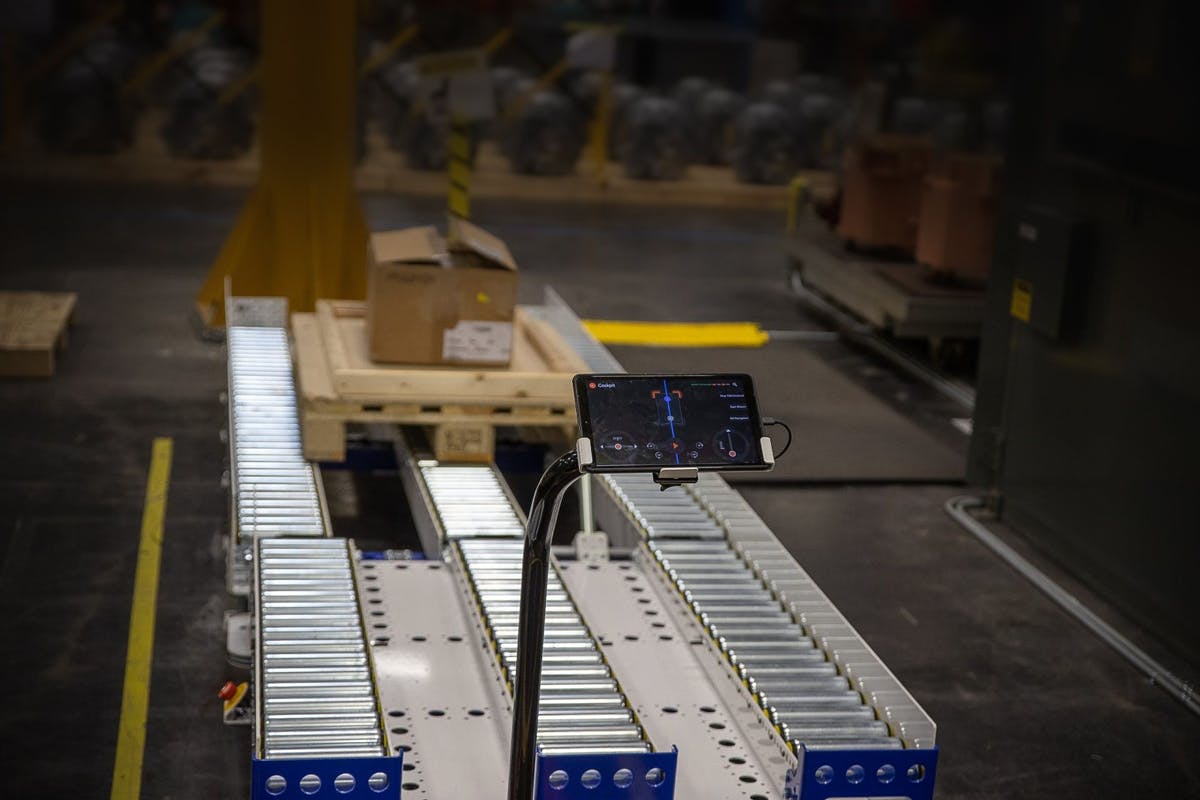
One of the standout AGV navigation systems in modern material handling – and the underlying technology of the FlexQube AGV System – is camera/optical line navigation. This system uses onboard cameras to see and follow visual cues like colored tape or painted lines.
A few of the primary strengths are:
- Accuracy: Vision-based tracking paves the way for consistent and repeatable routing.
- Fast deployment: Routes can be installed and modified quickly using colored tape or painted lines.
- No permanent infrastructure: No drilling, embedded materials, or fixed floor installations required.
- Easy route changes: Paths can be adjusted or expanded with minimal cost and downtime.
Our AGV System integrates this navigation approach with robust safety scanning and precision stopping, helping it maintain dependable, adaptable performance without Wi-Fi, embedded wiring, or reflectors.
AGV navigation – other aspects to consider
While navigation is at the heart of every AGV setup, it is only one element of a complete automation strategy. To make sure your system runs efficiently, consider the following aspects as well.
Fleet management
A robust fleet management system orchestrates traffic, task assignment, and vehicle status. This helps make sure multiple AGVs can work together efficiently without collisions or bottlenecks.
Safety systems
In workplaces where people and machines share the same space, it’s important to integrate the AGV system with safety scanners, emergency stops, and sensors that detect nearby workers or other obstacles.
Scalability and future growth
Invest in a navigation solution built for growth. With flexible options like our camera/optical navigation system, you can easily expand your AGV fleet without costly or time-consuming redeployment.
Integration with warehouse systems
Many AGV setups connect directly to warehouse management or control systems (WMS/WCS), making it possible to automate task assignments and keep data flowing in real time across your facility.
Up next

5 January 2026
AGV in manufacturing – safer and smarter operations
AGVs are self‑guided vehicles built to transport materials autonomously across factory floors and warehouses. They move materials, components or finished products through manufacturing lines without manual driving. By optimizing intralogistics, AGVs help reduce labor costs, improve safety, and ensure a steady, predictable material flow.

5 January 2026
FlexQube receives follow-up order worth $430,000 from U.S. customer
FlexQube has received a new follow-up order from the same U.S. customer, one of the world’s largest e-commerce and logistics companies based in the United States, that placed several pilot orders during the autumn. The new order amounts to approximately $430,000 and will be delivered during the first quarter of 2026.